
Greta Perry · 10 October 2026
Subterranean Fungal Networks Fortifying Maple Trees in Baltic-Influenced Forests
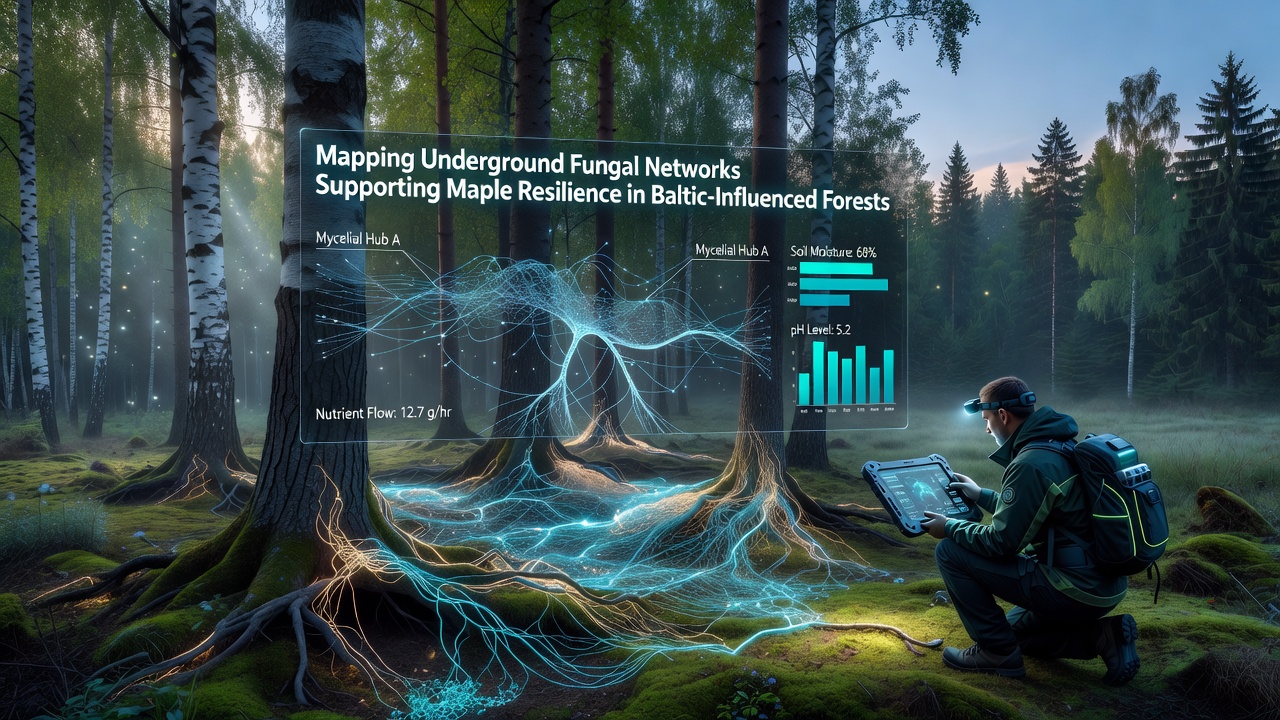
Researchers across northern Poland and adjacent Baltic states have expanded efforts to chart mycorrhizal fungal networks that link maple root systems in forests shaped by maritime air flows from the Baltic Sea, and these networks appear central to how Acer species maintain water uptake and nutrient exchange amid variable seasonal conditions.
Scientists employ soil core sampling combined with DNA metabarcoding to identify fungal species that form arbuscular and ectomycorrhizal associations with maples, while GIS layering helps track network density across elevation gradients and soil moisture zones typical of the region.
Methods Driving Current Mapping Projects
Teams collect root and soil samples during spring and autumn campaigns, then sequence fungal ITS regions to distinguish taxa that colonize maple roots more frequently than those of co-occurring species such as oak or pine, and this approach reveals spatial patterns where certain Glomeromycota and Basidiomycota dominate in sandy, well-drained profiles common near the Baltic coast.
Remote sensing via LiDAR supplements ground data by highlighting canopy density variations that correlate with belowground connectivity, allowing modelers to predict where fungal hyphae likely bridge individual trees over distances of several meters.
Role of Networks in Nutrient and Water Dynamics
Evidence indicates that these fungal webs facilitate phosphorus transfer from deeper mineral layers to maple roots during dry spells, while carbon compounds move from canopy photosynthesis into the shared mycelium, supporting fungal persistence through winter freezes that affect Baltic-influenced sites.
Studies in comparable temperate systems show similar linkages improve seedling survival rates by 20 to 30 percent when connected to established networks, and parallel observations are emerging from plots monitored in the Pomeranian and Warmian-Masurian voivodeships.
Regional Context and Ongoing Work
Baltic-influenced forests experience milder winters and higher humidity than inland continental zones, conditions that favor certain fungal communities yet also expose them to periodic flooding or salt spray near shorelines, and mapping initiatives now incorporate these variables into predictive models.
In October 2026 a multinational consortium plans to release an open-access database compiling network maps from 45 permanent plots spanning from Gdańsk Bay to the Curonian Spit, drawing on protocols refined through earlier European forest monitoring programs.
Observers note that such datasets could inform selective planting guidelines that prioritize maple genotypes showing stronger compatibility with locally dominant fungal partners, though field validation remains necessary before broad application.
Integration with Broader Forest Research
Canadian Forest Service reports on boreal maple stands demonstrate comparable mycorrhizal support mechanisms under fluctuating precipitation regimes, and researchers reference these findings when calibrating models for Baltic conditions where autumn rainfall patterns differ markedly. Natural Resources Canada publications provide baseline metrics on fungal biomass that help contextualize local measurements.
European Environment Agency summaries of soil biodiversity further supply regional benchmarks, allowing direct comparison of network extent between Baltic sites and those farther south in the continent.
Conclusion
Mapping continues to clarify how underground fungal connections sustain maple presence in Baltic-influenced forests by mediating resource flows and stress tolerance, and expanded datasets expected in late 2026 should refine understanding of these interactions across varying soil and climate gradients within the region.